A new online livestream showing large schools of fish gathering in warm water near the Bruce Nuclear Generating Station is drawing sharp criticism from the Saugeen Ojibway Nation (SON), which says the footage risks painting a misleading picture of the health of Lake Huron.
The livestream, branded by Bruce Power as "Nuclear Fish City," shows dense concentrations of fish in the plant's warm-water discharge area, a byproduct of the facility’s cooling system. The company and project partners have promoted it as a rare look at underwater life thriving in the Great Lakes.
But the Saugeen Ojibway Nation says what viewers are seeing is not a sign of a healthy ecosystem, but instead a warning sign.
In a media release, authors including fisheries biologist Ryan Lauzon describe the scene as something very different from the optimistic framing.
"If you read the publicity around Bruce Power's April 22 'Nuclear Fish City' live stream event, you might think the company has created something positive: a warm-water refuge where fish gather and thrive beside industry," the media release states. "That is the image being sold. The reality is much harsher."
Lauzon, who works as a fisheries biologist and aquatic science advisor with SON’s Environment Office, says the concern isn’t that fish are being seen, it’s why they are there.
Speaking in an interview with CKNXNewsToday.ca, Lauzon said his initial reaction to the livestream was mixed.
"As a fish biologist, I love fish," he said. "So hearing about a live stream and the excitement it generated about looking at fish...that’s exciting."
But he said that excitement quickly shifted when he considered what was actually being shown.
"The problem that I had was...there really wasn’t any discussion about why all these fish were actually congregating," Lauzon said. "And actually the risk that those fish can have by all congregating right at the nuclear plant."
At the centre of SON’s concerns is what’s known as a thermal plume, warmer water released from the plant into Lake Huron. That warmth attracts fish, especially in colder months when surrounding waters drop in temperature.
Lauzon says that attraction can be dangerous.
"There’s a real reason why these fish are there, and that’s because a lot of these fish are attracted to that thermal discharge," he said. "The problem is it actually can be a giant fish trap."
The term "fish trap" is used directly in the SON media release, which argues that the warm water acts as a kind of attractant, while the plant infrastructure itself becomes the hazard.
"You have a bait or an attractant, and that is really the warm water which is drawing fish in," Lauzon explained. "And then you have a mechanism, which is the plant, where these fish can actually get trapped inside and killed."
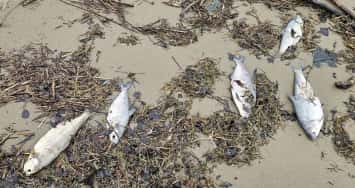
The concern is not hypothetical, according to SON. The media release points to a major fish mortality event in 2025 involving gizzard shad, when millions of fish were reported dead in connection with the facility.
"That’s where the whole idea of a fish trap comes about," Lauzon said. "And unfortunately, there’s an avenue where the fish can get into the plant infrastructure and ultimately be killed."
The Saugeen Ojibway Nation says that framing the plume as a "fish city" misses that broader context entirely.
"If you only get that side of story, you could easily be misled," Lauzon said. "You might think all these fish coming together means it’s a healthy ecosystem and things are all going great."
But he says what’s missing from the public presentation is equally important: what cannot be seen on camera.
"You don’t get that other side of the story about the potential risks for these fish," he said. "That’s really the missing piece."
The SON statement goes further, arguing that warm-water discharge from industrial activity does not create natural habitat, but instead alters fish behaviour and ecosystem dynamics in ways that are not always visible in livestream footage.
It also raises concern about accountability, pointing to past fish mortality events and saying environmental messaging should reflect full impacts, not just selective imagery.
Lauzon echoed that concern, saying the conversation needs to include what happens beyond what viewers see.
"We don’t hear about the accountability...or about past actions in the mass fish mortality that we saw," he said.
When asked what he would say to people watching the livestream and seeing what appears to be abundant fish life, Lauzon said context is everything.
"I really want somebody watching the footage to have all the information," he said. "It’s really nice to watch all these fish, but they need to be aware that these fish are actually in danger as a result of them all congregating together."
SON says it is not opposing collaboration with industry and has worked with Bruce Power on environmental concerns in the past. But it argues that real progress requires more than communications campaigns.
As the media release puts it, Lake Huron "is not an aquarium for corporate storytelling," but part of a living system that continues to face pressure.
And for Lauzon, the takeaway is simple: what looks like abundance on a screen doesn’t always tell the full story.
"If the public wants to watch fish on a camera," he said, "they need to ask a harder question: why are those fish there, and what is the camera not showing?"